Quick Answer
The introduction of the Canadian Dental Care Plan (CDCP) is welcome news for qualifying Canadian residents. Understanding how the guide works, and especially out-of-pocket costs, can be confusing for anyone unfamiliar with clinical terminology. However, a better understanding will help you and your family gain the most benefit from the CDCP.
It is important to understand that dental care is unlikely to be free, even for Canadian residents who qualify for 100% coverage. There will almost certainly be some out-of-pocket costs to pay, but essential preventive and restorative dental treatments should be easier to access affordably through dentists who accept CDCP coverage.
After reading this article you should have a greater understanding of how to navigate the CDCP guide, the difference between the CDCP guide and your provincial or territorial fee guide, and how these can affect your out-of-pocket costs. Remember that your oral healthcare provider can give you a clear explanation of any proposed treatment plan and any associated out-of-pocket costs.
What to Expect in This Guide
In this article, we will explain what the CDCP fee guide is and how it works. Below are the points we will cover.
- Navigating the CDCP Guide. How to navigate the CDCP Fee Guide by looking at examples of common treatments.
- Where to find CDCP fees. Learn how the CDCP Benefits Guide covers the services available under this plan. Separate provincial and territorial CDCP fee grids contain the pricing for the services covered under the benefits guide.
- Understanding how the CDCP Fee Guides work. We will discuss the CDCP fee guides and provide examples of price differences between provinces.
- Dental Association Fee Guides. We will explain how provincial and territorial dental associations produce their own fee guides annually.
- Examine the differences between the CDCP Fee Guides and Provincial fee guides. We look at the price differences between the CDCP and Provincial fee guides.
- Out-of-pocket costs. We provide further examples of how these differences affect out-of-pocket dental costs (including a comparison table).
Introduction
The CDCP was introduced to provide eligible Canadian residents with improved access to affordable preventive and restorative dental care. It aims to make it easier for Canadians enrolled in the plan to maintain good oral health. While the CDCP will cover part of the eligible treatment costs, the full fee charged by the practice may not be covered. In this case, patients must pay the difference or out-of-pocket costs.
The provincial or territorial CDCP fee guides include the costs covered by the CDCP for each procedure. The prices in the CDCP fee guides are not uniform and vary from one province to the next.
In some cases, patients who are eligible for 100% coverage under CDCP may still incur out-of-pocket costs even for CDCP eligible procedures. A common reason for this is the fact that CDCP fee guides (also known as CDCP fee grids) are different from the guides most dentists in Canada use to set their own prices.
What is the CDCP Fee Guide / Fee Grid and how to navigate it?
The CDCP fee guide was developed with the same methodology the government has employed with other federal programs such as the Non-Insured Health Benefits program for First Nations. Dental health practitioners were consulted throughout the development of the program and subsequent fee guide.
The CDCP produces fee guides or grids for every province and territory. There are four separate fee guides for each province or territory. These four fee guides cover general dentists and specialists, dental hygienists, denturists, and oral and maxillofacial surgeons.
The complete CDCP Fee Guides are available online. The information covered is comprehensive and includes clear instructions on eligibility and how to apply.
Some services listed in the CDCP fee guides are easy to navigate and understand. For example, a recall exam has a single code of 01202. The price difference depends on whether the patient sees a general practitioner (GP) or a pediatric dentist (Paed).

Emergency dental exams (code: 01205 )are another good example, as the price covered can depend on whether you see a general practitioner or need to see a specialist dentist, such as an Endodontist (Endo) or a Periodontist (Perio).

Some procedures have multiple codes and a range of fees. These codes can be more complex to understand. For example, your dentist might order several different dental x-rays to diagnose a problem. Each type of x-ray has a unique code but the fee guides do not explain the differences between each code. In this case it is best to ask your oral healthcare provider for a clear explanation.
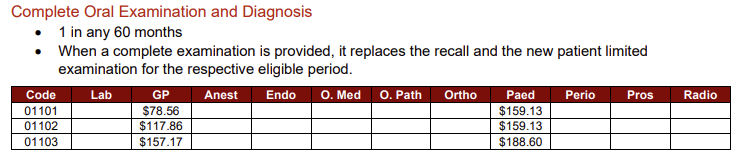
Every fee guide lists treatment codes used for procedures covered under the CDCP. The amount covered by the CDCP can differ between provinces.
Below is a table showing the differences between recall and emergency dental exams for adult patients in Alberta and British Columbia. As you can see, the difference can be significant.
| Code/ Treatment | Alberta | British Columbia |
| 01202/ Recall Examination | $72.32 | $32.73 |
| 01205/ Emergency Examination | $72.32 | $59.50 |
Each fee guide lists the same treatments, but the codes can differ slightly from province to province.
For example, the table below shows that codes and prices for recall and emergency examinations by a general dentist in Alberta and Quebec are slightly different.
| Province | Code/ Treatment | Maximum Covered for an Adult Patient |
| Alberta | 01202/ Recall Examination | $72.32 |
| Quebec | 01200/ Recall Examination | $85.85 |
The treatment codes for standard procedures, such as a recall examination, are relatively easy to navigate. However, some of the other codes in these guides can be more complex.
For example, if you need a dental filling, the code will depend on the number of tooth surfaces requiring restoration. More complex codes will require an explanation from your dentist or oral healthcare provider.
Navigating the CDCP Benefits Guide
The CDCP Dental Benefits Guide includes detailed information on the services covered. The services are listed by category, making searching for specific treatments easier.
For example, when you see a new dentist, you must have a dental examination. There are frequency limitations, so you can only have one recall dental exam in any 12-month period. However, if you need an emergency dental exam, for example, if you develop a severe toothache, you can still see a dentist urgently. There is no frequency limit on emergency dental exams.
Another example is a hygiene appointment to have your teeth cleaned professionally. It is a preventive dental care treatment that will help you easily maintain healthy teeth and gums.
Adults aged 17 and older can have four units of scaling in any 12 months, while polishing is limited to ½ a unit in any 12 months.
The treatments covered and frequency limitations are laid out clearly in tables.
The CDCP Benefits Guide on the Government of Canada website is designed to work with the CDCP fee grids (guides) on the Sun Life website. The CDCP Benefits Guide states which services are covered across the country. The fee guides on the Sun Life website show the maximum amount covered in each province.
What are the Dental Association Provincial and Territorial Fee Guides?
Every provincial and territorial dental association produces its own fee guide annually. These guides use the same codes as the Sun Life fee grid.
The purpose of these fee guides is to provide guidelines on pricing for dentists in each province and territory. However, while many dentists will use these guides when structuring their fees, they are not obligated to follow these fees. They are simply a suggestion. The actual price charged by your dentist could be higher.
Some dental associations have links to abbreviated fee guides on their websites. Otherwise, your local library may have a copy. You can read more about the Dental Association provincial fee guides here.
What are the Differences Between the CDCP Fee Grids and Provincial Fee Guides?
The main difference between the CDCP Fee Grids and Provincial Fee Guides is that the total amounts covered by the CDCP will often be lower. The exact percentage difference is not uniform across the country. Fees are set higher in some provinces, similar to the provincial fee guides.
The difference between the two prices creates a gap. These gaps are called out-of-pocket costs, and patients are responsible for covering them even if they qualify for 100% coverage through the CDCP.
The table below shows the difference between the CDCP fee for Ontario and the Ontario Dental Association's suggested dental exam and diagnosis fees.
Note that the CDCP fee shown in the grid is the maximum amount CDCP will reimburse for someone with 100% coverage.
| Code | CDCP Fee for Ontario 2024 | Ontario Dental Association (ODA)Suggested Fee Guide 2024 | Difference at 100% Coverage (Adjusted family net income of less than $70,000) | Difference at 60% Coverage (Adjusted family net income of $70,000-$79,999) | Difference at 40% Coverage (Adjusted family net income of $80,000-$89,999) |
| 01103 Examination and Diagnosis: Complete, Permanent Dentition | $157.17 | $178.00 | $20.83 – the price difference between the CDCP fee and the ODA suggested fee | $62.86 + $20.83 = $83.69 – the percentage covered by the CDCP plus the payment gap between this percentage and the ODA suggested fees | $94.30 +$20.83 = $115.13– the percentage covered by the CDCP plus the payment gap between this percentage and the ODA suggested fees |
The above table shows the price the CDCP will cover for a specific treatment code in a specific province, in this case, Ontario and the Ontario Dental Association suggested fee.
Columns three to six show the actual cost for adjusted family net income levels of less than $70,000, between $70,000 and $79,999 and between $80,000 and $89,999.
Even someone with an adjusted net family income of less than $70,000 will still be responsible for the gap payment, the price difference between the amount covered by the CDCP and the actual price charged by the dentist.
A patient qualifying for 100% coverage could be responsible for a fee of $20.83. The price could be higher if the dentist charges more for a dental exam than the fees suggested in the ODA Suggested Fee Guide.
The table below shows two other examples of how out-of-pocket costs are calculated. This time, we are looking at two more common dental procedures: a single bitewing x-ray and one unit of scaling (each unit lasts 15 minutes).
| Code | CDCP Fee for Ontario 2024 | Ontario Dental Association (ODA)Suggested Fee Guide 2024 | Difference at 100% Coverage (Adjusted family net income of less than $70,000) | Difference at 60% Coverage (Adjusted family net income of $70,000-$79,999) | Difference at 40% Coverage (Adjusted family net income of $80,000-$89,999) |
| 02141 Single bitewing x-ray | $32.30 | $40 | $7.70– the price difference between the CDCP fee and the ODA suggested fee | $12.92 + $7.70 = $20.62– the percentage covered by the CDCP plus the payment gap between this percentage and the ODA suggested fees | $19.38 + $7.70 = $27.08 – the percentage covered by the CDCP plus the payment gap between this percentage and the ODA suggested fees |
| 11111 One Unit Scaling (15 minutes) | $69.00 | $73.00 | $4.00 – the price difference between the CDCP fee and the ODA suggested fee | $27.60 + $4.00 = $31.60 – the percentage covered by the CDCP plus the payment gap between this percentage and the ODA suggested fees | $41.40 + $4.00 = $45.40 – the percentage covered by the CDCP plus the payment gap between this percentage and the ODA suggested fees |
The price difference between the CDCP and provincial fee guides is relatively low in these examples. However, it is important to remember that dentists do not charge the same amounts. Their prices may be higher or lower than the suggested prices in their provincial fee guide. For example, a dentist in downtown Toronto may have higher overhead costs than a practice in North York, and therefore charge higher fees.
These guides can give you an idea of your potential out-of-pocket costs, but you will need to know the actual prices charged by your dentist to calculate them accurately. It is also important to remember that these prices are updated annually and to use the latest guide for reference.
Conclusion
Using the CDCP fee guides and comparing them with those produced by your province or territory can provide a reasonable starting point for calculating the potential out-of-pocket costs of a procedure. However, it is important to understand how these costs can vary, and understanding the codes used can be complex without an explanation from a dental professional familiar with them.
When you see your CDCP dentist or oral healthcare provider for treatment, they should be able to give a proper breakdown of their prices. They can explain how these prices correlate with the CDCP and advise you on out-of-pocket expenses before you begin any proposed treatment plan.